
Phantom Lines: The Culminating Project of the Yale-China Arts Lab
THE YALE-CHINA ASSOCIATION AND
THE INTERNATIONAL FESTIVAL OF ARTS & IDEAS ANNOUNCE
PHANTOM LINES THE CULMINATING PROJECT OF THE YALE-CHINA ARTS LAB
IN PARTNERSHIP WITH THE YALE SCHOOL OF ART
Three theatrical designers are creating an installation that fuses music, nature, and an exploration of the evolution of the Chinese language.
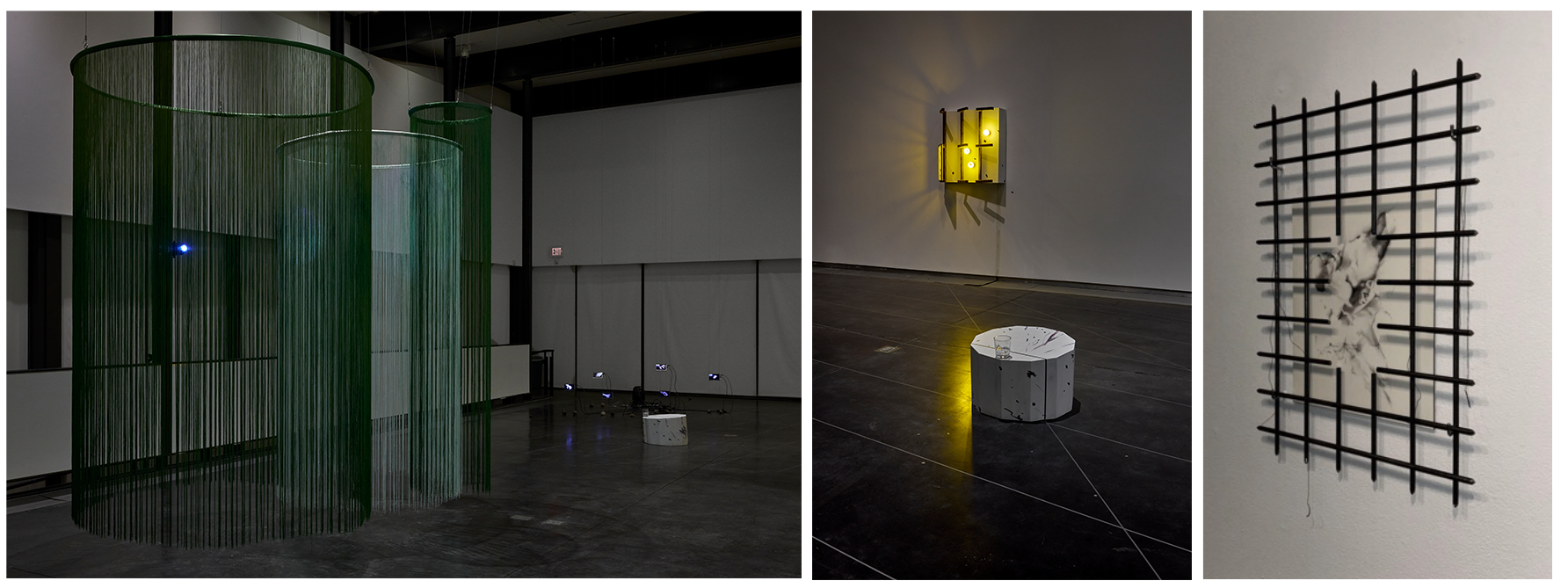
Photo credit: Chen Xiangyun
New Haven, CT, June 5, 2026. The Yale-China Association and New Haven’s International Festival of Arts & Ideas are proud to partner for a third year to present the culminating public showing of a residency program for graduate students in the arts. This year’s presentation features four artists from the Yale School of Art. The residency supports emerging artists in creating new intercultural work that – in process and presentation – brings together students, artists, and audiences from New Haven, Yale, and the world.
This year’s Resident Artists are all graduating master’s level artists and designers: Amy Fang (Graphic Design), Joy Li (Sculpture), Camille J-M Gwise (Graphic Design) and Shellie Zhang (Sculpture). The group has been working together since January to create a group exhibition that presents a reflection on the afterlives of silk as commodity, object, material, and industry, and its historical entanglement with China.
The exhibition considers silk as both a material and a system shaped through processes of making, circulation, and exchange—from its roots in sericulture, to its movement along the Silk Road, its history in New Haven and its dissemination through contemporary global trade, as well as its emblematic associations with Chinese culture. By following the threads of these intertwined histories, Phantom Lines reveals how silk’s cultural, economic, and political legacies continue to shape the ways it is understood, imagined, and encountered today.
Born in Tianshui, a city along the historic Hexi Corridor of the Silk Road, Joy Li imagines travelers crossing the Silk Road a thousand years ago and uses contemporary materials to link the experience of the ancient trade route to the realities of globalization today. Drawing influence from the craft traditions of Suzhou and silk histories of New Haven, Shellie Zhang’s work follows the intertwined journeys of silkworms and mulberry trees as a way of thinking through migration, cultivation, and the conditions that shape growth and change. Amy Fang’s work, shaped in part by archival images of Anna May Wong from the Beinecke Library, considers silk as both a fabric of status and a connective tissue, shaping how bodies are read, held, and adorned.
Together, the group approached silk not as a fixed cultural object, but as a history that continues to influence a new generation of artists. As the group explains: “Silk has been intrinsically linked to Chinese culture and people. In this exhibition, we dig into its layered history to offer personal reflections on how it continues to shape global trade, migration, and bodies.”
Visitor Info
Phantom Lines will be open to the public on weekends from May 24 to June 15, 12 – 4 PM
at the Yale School of Art Edgewood Gallery at 32 Edgewood Ave in New Haven, CT.
A public reception and performance by Camille J-M Gwise will be held on Saturday, June 6, 6-8PM.
Advance free registration on the IFAI website is suggested but not required.
For more information about the project, contact Michael Leibenluft at the Yale-China Association at
Michael.leibenluft@yale.edu.

Artist Bios
Amy Fang
Amy Fang is an interdisciplinary artist and designer whose practice examines the fashioning and unfashioning of the racialized body.
Fang’s work draws on the sociocultural histories of stretch fabrics, recontextualizing these materials as “second skins,” and as a form of shanzhai—a Chinese term for counterfeit, or a poor imitation. Her research investigates the ways in which material signifiers of status undergo shifts in value through cross-cultural circulation. Through this lens Fang foregrounds the fragile, wistful, and often tenuous relationships between disseminated copies and their original sources.
In Fang’s work, silk is represented as both skin and membrane: stretched, suspended and layered against reflective and industrial materials. Beyond its associations with softness and delicacy, silk possesses a tensile strength and biological compatibility, a material that moves intimately between body and object. In these works, silk operates both as adornment and as a fragile connective tissue. These works are informed in part by staged portraits of the actress Anna May Wong, the first Chinese American film star in Hollywood, posed against silk backdrops, sourced from Yale’s Beinecke Rare Book and Manuscript Library. Fang similarly approaches silk as a material that stages the body: a second skin through which racialization and visibility are performed and negotiated. Rather than reconstructing images directly, the works present encounters between opacity and display, containment and exposure. In this way, the sculptures examine how bodies and histories are archived through surfaces and what can be remembered through touch.
Camille J-M Gwise
Camille is an interdisciplinary designer. Her practice collages material processes of drawing, writing, printmaking, and performance in service of making images, both still and moving. She works independently and with others to make books, installations, performances, visual identities, and the occasional typeface.
Camille will present a performance centred on women thread to take place on June 6, 2026 at the reception.
Joy Li
Joy Li was born in 1999 in Gansu, China. She obtained her BFA degree in Interdisciplinary Sculpture with a Theater minor at Maryland Institute College of Art in 2021. She is currently studying in the MFA Sculpture program at Yale School of Art, expected to graduate in 2026. Her works include sculpture, performance art, theater, video, and music, exploring the tension of interactions between objects, emotions, and relationships. In her works, she reinterprets objects and bodies to magnify the allure and danger inherent in everyday items, allowing the audience to re-experience and interact with familiar things in unfamiliar ways.
Joy’s work reflects on the Silk Road’s history. The opening of the ancient Silk Road began when Emperor Wu of Han sought superior warhorses from the Western Regions to fight against the Xiongnu. He dispatched Zhang Qian on a diplomatic mission to the West, and through this journey, the world unfolded. During his first expedition, Zhang Qian was captured by the Xiongnu and detained for more than ten years. By the time he returned to Chang’an, thirteen years had passed.
Today, the tools of travel are more convenient than ever before, yet the world has not become a completely open place. Amid this vast uncertainty, Joy reflects on how we locate ourselves, which has led her to imagine the travelers of the ancient Silk Road a thousand years ago — crossing mountains beyond mountains, deserts beyond deserts — seeing mirages along the journey, visions of moments in life from which there is no return.
Shellie Zhang
Shellie Zhang is a multidisciplinary artist based in Toronto and New Haven. Working across a range of media, Zhang explores how legacies of translation, migration, and memory leave traces and impressions across bodies, materials, and images. She is interested in how symbols and iconographies shift across generations, carrying histories that are inherited, transformed, and reimagined over time. Drawing on motifs of transformation and adornment from both the natural and constructed world, she investigates surfaces as perceptual thresholds that register the imprints of metamorphosis and adaptation.
Shellie’s work began with research into the history of silk production in New Haven and the relationship between the silkworm and mulberry tree that made sericulture possible The industry briefly flourished after the introduction of the Chinese white mulberry tree, valued for its rapid growth and abundant leaves, but speculative investment soon inflated its value beyond the silk it could produce. Outbreaks of blight devastated orchards, and by the 1840s Connecticut’s sericulture industry had largely collapsed. Today, white mulberry trees persist across the region as an invasive species.
Zhang’s work draws from the parallel journeys of the silkworm and mulberry tree as lifeforms shaped, displaced, and instrumentalized by industry. Within sericulture, silkworms are sacrificed for their cocoons, while mulberry trees, once cultivated for profit, have since been recast as invasive. Brought to foreign lands and made mutually dependent, both species become metaphors for adaptation, cultivation, and selective desirability. Through sculpture and installation, Zhang meditates on their relationship, considering the tree and cocoon as sites of shelter and containment, and tracing how cycles of growth and metamorphosis can be interrupted, redirected, or stunted.